
The Claritas Publishing memory work guides include one or two main science subjects each year. I have added to those subjects to provide a large buffet of choices for your family. When you come back around to a cycle again, you can either dig deeper into a science subject you have already covered, or choose to move on and cover another subject. It’s also Charlotte Mason-style to read little bits of lots of different subjects, over time, so don’t feel limited to covering only one or two science topics per year.
Nature & Animals
- Cycle 1 Form 1+
- Cycle 1 Form 2+
- Cycle 1 Form 3+
- Cycle 2 Form 1+
- Cycle 2 Form 2+
- Cycle 2 Form 3+
- Cycle 3 Form 1+
- Cycle 3 Form 2+
- Cycle 3 Form 3+
- Cycle 3 Form 4+
- Cycle 4 Form 1+
- Cycle 4 Form 2+
- Cycle 4 Form 3+
- Cycle 4 Form 4+
Projects
Anatomy
Astronomy
Biology
Birds
Botany
Chemistry
Creation
- Cycle 1 Form 1+
- Cycle 1 Form 3+
- Cycle 1 Form 4+
- Cycle 2 Form 1+
- Cycle 2 Form 2+
- Cycle 2 Form 3+
- Cycle 3 Form 1+
- Cycle 3 Form 3+
- Cycle 4 Form 1+
- Cycle 4 Form 3+
Ecosystems and Habitats
Food Science
Forests & Trees
Geology
Insects
Oceans
Physical Science/Physics
Weather
You can download the pdf schedules at the STAR Store
How to Teach Science
1. Go outside and look at nature every day!
2. Read science lessons a couple of times per week.
3. Ask your child to tell you what they heard you read.
4. Do a lab assignment or nature activity once every week or two.
That’s all!
Science & Nature: Scope and Sequence
There are some really special things about the four cycle approach to homeschooling. One is predictability, and knowing what’s ahead. Homeschool moms may wonder how they will cover all the subjects with their kids? I understand this concern! While I don’t believe you have to teach your child everything (because, even as adults, they will be learners), I want to show you how you can get through a lot of science and nature topics in your homeschool days with them.
Choose One or More Subjects Per Year
If you’re going through the four cycles with your children repeatedly, you should be able to hit each cycle three times before they graduate from high school. With this in mind, you can choose one or two subjects each year and do a deep dive into those subjects–knowing that you will come back to the cycle and will hit another subject at that point.
Some Cycles Have More Topics than Others
You will notice that some cycles have more topics than others. This is because some topics (like Biology) are broad and cover a lot, and may be repeated a couple of times. And, some topics line up naturally with other topics. Do not feel pressured to study every single topic! Choose your favorites and then choose to enjoy your time focusing on those topics.
Topics Offered in Every Cycle
There are a couple of topics offered every year: Creation Science, and also General Nature. Creation Science is about the God of the Universe creating the world, and this is a foundational subject for all children to learn. General Nature includes books with nature study that doesn’t necessarily fit into one category, or isn’t easily categorized.
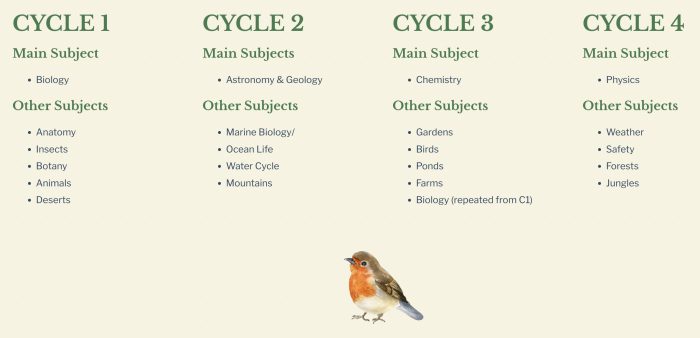
The Cycles & Science and Nature Topics:
Cycle 1: Science
- Creation, Nature & Animals, Biology, Anatomy, Botany
Cycle 2: Science
- Creation, Nature & Animals, Astronomy, Geology, Marine Biology
Cycle 3: Science
- Creation, Nature & Animals, Chemistry, Food Science, Birds
Cycle 4: Science
- Creation, Nature & Animals, Physics, Safety, Weather
As you can see, there are lots of options! And, there is a plan for science, so that, if you choose to follow The STAR cycles, there will be some order to your choices.
The Claritas Publishing Memory Work, which is optional, but wonderful, covers the following science topics:
Cycle 1: Biology
Cycle 2: Astronomy & Geology
Cycle 3: Chemistry
Cycle 4: Physics
The STAR cycles follow the Claritas cycles, and then I have added other topics to this list, in order to provide a robust education, and to make use of many wonderful resources over the years you homeschool your children.
I hope this is helpful!