
Reading stories together is a precious way to spend time as a family.
Read Aloud Books
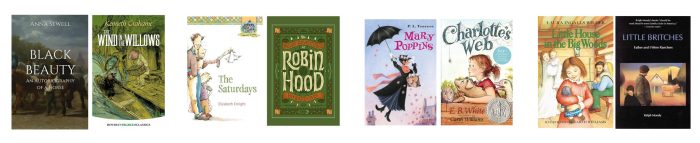
There are read aloud books scheduled for each week, at a pace of approximately four chapters per week (depending on the length of the length of the chapters). At STAR Homeschool Community, families with students in Forms 2 and 3 are reading these books and discussing them in class. Below are pictures of just two of the books for each cycle.
In addition, there is one story per week (28 stories total) scheduled for Form 1 students (picture books).
- Cycle 1 Read Aloud Form 1b+
- Cycle 1 Read Aloud Form 1a+
- Cycle 2 Read Aloud Form 1b+
- Cycle 2 Read Aloud Form 1a+
- Cycle 3 Read Aloud Form 1b+
- Cycle 3 Read Aloud Form 1a+
- Cycle 4 Read Aloud Form 1b+
- Cycle 4 Read Aloud Form 1a+
New Literature Titles (Rough)
- Cycle 1 New Literature Titles
- Cycle 2 New Literature Titles
- Cycle 3 New Literature Titles
- Cycle 4 New Literature Titles
Language Arts
A Charlotte Mason purist would only use narration, dictation and copywork until the student is in middle school or higher. I describe how to do all of that in the online portal. I also suggest multiple language arts programs and I suggest how to schedule those, as well.
Form 4 and 5 students are introduced to beautiful and classic literature and have writing assignments scheduled as well.
- All Cycles Language Arts
- Cycle 1 Literature and Language Arts Form 4+
- Cycle 2 Language Arts & Literature Form 4+
- Cycle 3 Language Arts & Literature Form 3+
- Cycle 3 Language Arts & Literature Form 4+
- Cycle 4 Language Arts & Literature Form 4+
Fairy Tales, Fables and Myths
- Cycle 1 Fairy Tales, Fables and Myths Form 0
- Cycle 1 Fairy Tales, Fables and Myths Form 1
- Cycle 1 Fairy Tales, Fables and Myths Form 2
- Cycle 1 Fairy Tales, Fables and Myths Form 3
- Cycle 2 Fairy Tales, Fables and Myths Form 0
- Cycle 2 Fairy Tales, Fables and Myths Form 1
- Cycle 2 Fairy Tales, Fables and Myths Form 2
- Cycle 2 Fairy Tales, Fables and Myths Form 3
- Cycle 3 Fairy Tales, Fables and Myths Form 0
- Cycle 3 Fairy Tales, Fables and Myths Form 1
- Cycle 3 Fairy Tales, Fables and Myths Form 2
- Cycle 3 Fairy Tales, Fables and Myths Form 3
- Cycle 4 Fairy Tales, Fables and Myths Form 0
- Cycle 4 Fairy Tales, Fables and Myths Form 1
- Cycle 4 Fairy Tales, Fables and Myths Form 2
- Cycle 4 Fairy Tales, Fables and Myths Form 3
Fairy Tales, Fables and Myths are optional. Some mamas prefer not to read these stories to their children because there are some dark stories out there! (Grimm’s Fairy tales are particularly dark! Did you know Cinderella’s step sisters cut off their toes to fit in the glass slipper? Yes…Dark!). I found this funny meme online that kind of explains what I’m saying here (Grimm was German):
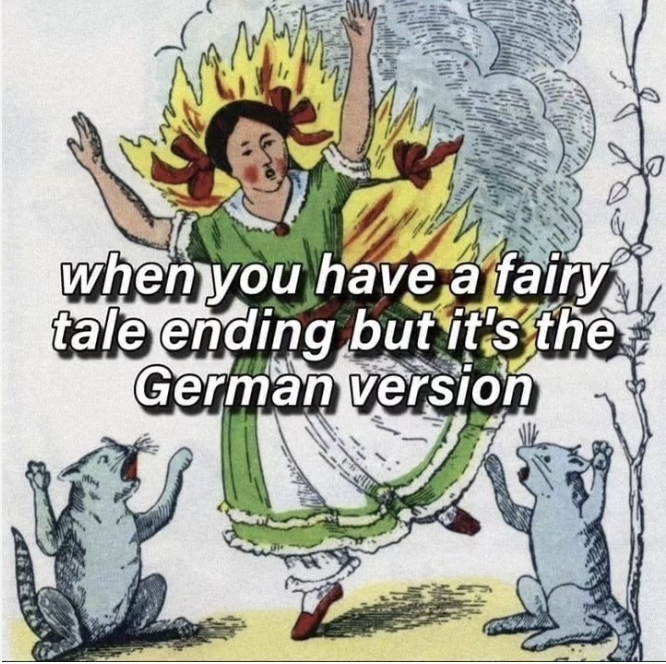
But really…should you read these stories to your children? I suggest that you pre-read these stories to see if they are a good fit for your family.
Personally, I have read Fairy Tales, Fables and Myths to all of my children, though we didn’t spend a lot of our school day on these subjects. I majored in English (my final degree was in Culture, Literature & the Arts), and I see a huge benefit to reading literature. Here are a couple of reasons I support reading these stories:
- You will find references to many of these stories throughout culture, and knowing these stories adds to a deeper understanding of some conversations and situations.
- Our son has been on missions trips to different countries for two whole summers, and he said that he is so grateful that he was introduced to these kinds of stories, because it helped him relate to people in other cultures.
- These stories provide a way to learn some life-lessons without having to live through the scenarios to learn the same lessons in-person.
- There isn’t an easy distinction between works of literature that might be considered fairy tales, or simply; fiction. I think it would be easy to start ruling out all fiction if we aren’t careful with our standards, and I believe that literature is beneficial. Where would the joy be in a homeschool day with only facts and personal accounts of true stories read aloud? Literature stirs a child’s imagination, and then invites a child in to hear a lesson in a way that no other form of literature is able to do.
All that said, I want to explain show you the optional book selections I’ve chosen for each form and cycle:
Form 0 (under 6 years old)
Form 1b (1st grade)
- All Cycles: Aesop’s Fables for Children
- Cycles 1 & 2: An Illustrated Treasury of Hans Christian Andersen’s Fairy Tales Illustrated by Anastasiya Archipova
- Cycles 1 & 2: Usborne Illustrated Hans Christian Andersen’s Fairy Tales by Anna Milbourne
Form 1a (2nd-3rd grade)
- Cycle 1: Fairy Tales Too Good to Miss: Along the Way by Lisa M. Ripperton
- Cycle 2: Fairy Tales Too Good to Miss: In the Meadow by Lisa M. Ripperton
- Cycle 3: Fairy Tales Too Good to Miss: Around the Fire by Lisa M. Ripperton
- Cycle 4: Fairy Tales Too Good to Miss: Up the Stairs by Lisa M. Ripperton
Notice, students before 4th grade are not introduced to any mythology.
Form 2 (4th-6th grade)
- All Cycles: Hans Christian Andersen’s Complete Fairy Tales by Hans Christian Andersen (Author), Jean Pierre Hersholt
- Cycle 1: Fairy Tales Too Good to Miss: Into the Woods by Lisa M. Ripperton
- Cycle 1: The Blue Fairy Book by Andrew Lang (Year 1 of 2)
- Cycle 1: D’Aulaire’s Book of Greek Myths
- Cycle 1: The McElderry Book of Greek Myths Retold by Erc A. Kimmel
- Cycle 1: Gilgamesh the King Retold by Ludmila Zeman
- Cycle 1: The Revenge of Ishtar Retold by Ludmila Zeman
- Cycle 1: The Last Quest of Gilgamesh by Ludmila
- Cycle 1: Gilgamesh the Hero by Geraldine McCaughrean (Scheduled in Historic Literature)
- Cycle 2: Fairy Tales Too Good to Miss: Beneath the Tower by Lisa M. Ripperton
- Cycle 2: The Blue Fairy Book by Andrew Lang (Year 2 of 2)
- Cycle 3: Fairy Tales Too Good to Miss: Beside the Sea by Lisa M. Ripperton
- Cycle 4: Fairy Tales Too Good to Miss: Aboard the Ship by Lisa M. Ripperton
Form 3 (7th-8th grade)
- All Cycles: The Complete Grimm’s Fairy Tales
- Cycle 1: Fairy Tales Too Good to Miss: Upon the Rock by Lisa M. Ripperton
- Cycle 1: A Wonder Book for Girls and Boys by Nathaniel Hawthorne
- Cycle 1: Tanglewood Tales by Nathaniel Hawthorne
- Cycle 1: Black Ships Before Troy: The Story of the Iliad by Rosemary Sutcliff
- Cycle 1: The Wanderings of Odysseus: The Story of the Odyssey by Rosemary Sutcliff
- Cycle 2: Fairy Tales Too Good to Miss: Across the Lake by Lisa M. Ripperton
- Cycle 3: Fairy Tales Too Good to Miss: Out of the Cave by Lisa M. Ripperton
- Cycle 4: Fairy Tales Too Good to Miss: Between Two Worlds by Lisa M. Ripperton
Form 4 (9th-10th grade)
- Cycle 1: The Odyssey by Homer (Scheduled in Language Arts, Track 1)
- Cycle 1: Antigone by Sophocles (Scheduled in Language Arts, Track 1)
- Cycle 1: The Aeneid by Virgil (Scheduled in Language Arts, Track 1)
- Cycle 1: The Epic of Gilgamesh (Scheduled in Language Arts, Track 2)
- Cycle 2: Beowulf
I will be adding more books to this list in the future. Watch for announcements about this!
If you’d like to do some more research, here are some good resources:
- Answers in Genesis: Greek Mythology and the Gospel of Jesus Christ: What Can We Learn?
- The Literary Life Podcast: Why Read Fairy Tales?
- The Commonplace: Why We Read Fairy Tales, Part 1
- The Commonplace: Why We Read Fairy Tales, Part 2 (Or, Magic!)
- Humility & Doxology: Finding the Gospel in Fairy Tales
- Ambleside: Christians, Charlotte Mason, and Fairy Tales
- Memoria Press: Fairy Tales and the Awakening of the Moral Imagination
- Memoria Press: Pagan Classics: Should Christians Read Them?
How to Teach Literature
Choose the literature tracks that you would like to study this year. You can either read about these books as a family, or each child who is able to read independently can study a track or two of literature on their own. Or, perhaps you will read about one person as a family and have each child read about another person.
When you or your child sits down to read historic literature, make sure to have the following tools on hand: a timeline book or book of centuries, maps of the world and of the U.S., and a writing utensil. Find the locations that are mentioned in the book. Write down the significant dates in your timeline book. This will solidify the learning and help tie it together to other subjects you read about with your child.
Have your child narrate what he or she learned. There are different ways to do this:
- Have your child tell back what they learned in a chapter.
- Ask your child to write or draw what they learned in a chapter.
When you choose a book, make sure to pay attention to the “Form.” The Forms are groups of grade levels. (See the section on Forms in the Welcome module).
If a book was placed under a “Form,” that means that the child should probably be in that Form (or higher) to read it independently. Any of the books listed can be read aloud, though you may want to check the content of some of the Form 4 and 5 books before reading them to a young child.
I am a big advocate of “Whole Family Homeschooling,” and Literature is one of the topics that is easy to teach to all of your children at once. This can be done by reading one or two books aloud to your kids–or, have them narrate out loud to each other what they’ve been learning in a book.
You may wish to print the reading schedules for people you have chosen for the year, or add the assignments to your homeschool planner or personalized spreadsheet. It is not necessary to print this entire document.
When more than one chapter is assigned to a week, I have typed each chapter on a separate line, so that the reading plan to be printed and used as a checklist throughout the term. As you read one chapter, put a checkmark by it or cross it out (or both), and move on to the next chapter on another day.
Using Literature for Every Subject
You can use literature to teach every single subject. I really shouldn’t tell you this, because you may not use any of the other subjects I’ve put together after this. 😅As you read a book out loud, listen for the following subjects:
- Geography
- History
- Science, Nature
- Math
- Art and Handicrafts
- Life Skills (Cooking, etc.)
- Enrichment (Composers, Artists, Poets)
Finish reading the section or chapter, and then go explore or DO the thing the book mentioned. Make the craft or recipe. Look up the places on a map, or better yet, on Google Earth. For example, when my kids were younger, we learned that Benjamin Franklin once lived on Milk Street in Philadelphia, so we looked it up on Google Earth. It looks quite busy today!
If the book mentions a song, listen to it. If there is a poem in the book, look it up (many poems are available online for free). Explore the kinds of nature that are mentioned. Find the type of tree, look for the kinds of clouds, go to a zoo and see the types of animals. Make literature come alive.
Some people might say that this doesn’t fit with Charlotte Mason’s methods, because it’s more of a “Unit Study,” and that it really benefits the teacher more than the students. In my experience, my children LOVED this kind of homeschooling. We made so many memories this way. I pray that you and your children will make memories around literature, too!